
How SolarShare Is Responding to Canada’s Anti-Greenwashing Rules
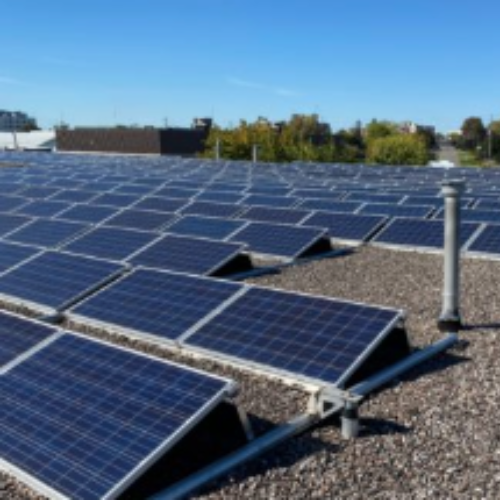
SolarShare has been building and financing community-owned solar energy in Ontario since 2010. We own and operate 51 solar projects representing 15.08 MW DC of installed capacity. In 2025, those projects generated 16,541 MWh of renewable electricity, enough for 1,848 Ontario homes
The first part of that paragraph are facts drawn directly from our project and generation data. Basic stuff. At the end, we make a secondary environmental claim:1,848 Ontario homes.
What’s the difference? “16,541 MWh generated” is a measured result. “Equivalent to the electricity used by 1,848 homes” is a derived claim that combines our generation data with an external benchmark and a calculation. Both can be useful, but the second requires us to document how we got there.
Over the past year, we have been reviewing the environmental claims we make, identifying the evidence behind them, documenting how our calculations work and establishing a process for keeping those claims current. It has become an important part of SolarShare’s broader sustainable finance work, because credible sustainable finance depends on credible environmental information.
That work matters because organizations like ours depend heavily on trust. Mission-driven organizations, co-operatives and nonprofits ask people to believe that their money is accomplishing something beyond generating a financial return. That trust takes years to build and can disappear quickly when an organization makes a claim it cannot adequately explain, or worse, that turns out to be false. At SolarShare: if we make an environmental claim, we should be able to show where it came from. And the law is starting to catch up.
Why Canada Changed the Rules
Canada has long prohibited false and misleading advertising under the Competition Act. In June 2024, amendments added specific requirements concerning environmental claims. Among other things, claims about the environmental benefits of a business or business activity must have adequate and proper substantiation, while certain environmental claims about products must be supported by adequate and proper testing.
There is a good policy reason for this. Environmental performance increasingly influences what people buy and where they invest. The Competition Bureau has noted that businesses have responded by presenting products and activities in increasingly “green” terms, while misleading environmental representations have also become more common. Greenwashing can mislead people into believing that their choices have environmental attributes or benefits that the evidence does not support, and it can disadvantage businesses that make more careful claims.
This is particularly relevant to sustainable finance, where environmental claims can influence investment decisions and the allocation of capital. Investors need to know that a “green” investment, project or financing product is supported by evidence rather than broad marketing language.
The rules do not mean organizations should stop discussing environmental benefits. Businesses remain free to make environmental claims, provided they are truthful, appropriately substantiated where required, specific and not exaggerated. The objective should be better environmental information, especially where that information is being used to support sustainable finance decisions.
Why Being a Solar Company is not Enough
Solar energy is a renewable source of electricity. That gives SolarShare a strong factual basis for discussing environmental performance. It does not mean every claim we could make about solar energy is automatically substantiated.
Consider the claim we made above: our projects generate enough electricity to power 1,848 homes.
The starting number is relatively easy to establish. SolarShare's projects generated 16,541 MWh of electricity in 2025. But electricity production by itself does not tell us how many homes that represents.
We need another piece of evidence: how much electricity an Ontario residential customer uses. Our methodology uses an Ontario Energy Board three-year average of 746 kWh per month, equivalent to 8.952 MWh annually. Divide SolarShare's 16,541 MWh of 2025 generation by that figure and the result is approximately 1,848 Ontario residential customers.
That exercise changed how we state the claim. Saying that our generation was equivalent to the annual electricity consumption of approximately 1,848 Ontario homes is more precise than saying SolarShare “powered 1,848 homes.” The former describes the calculation we actually performed.
Greenhouse-gas claims require another layer of analysis. SolarShare estimates that its 2025 generation corresponded to approximately 629 tonnes of avoided CO₂e emissions. There is no carbon meter attached to a solar panel that measures avoided emissions. We begin with our actual electricity generation and apply an Ontario electricity emissions factor. For the relevant reporting period, our calculation uses an Environment and Climate Change Canada factor of 0.038 tCO₂e per MWh:
16,541 MWh × 0.038 tCO₂e/MWh = approximately 629 tCO₂e.
That is an estimate built from evidence and a documented methodology. It's also important to identify Ontario as the relevant electricity system, because the carbon intensity of electricity differs significantly between provinces and changes over time.
Even apparently simple facts can contain methodological choices. SolarShare reports 15.08 MW DC of installed solar capacity. Why specify DC? Solar projects can be described by the DC capacity of their photovoltaic panels or by their AC output after the electricity passes through an inverter. Some SolarShare projects, for example, have 600 kW DC of panels and 500 kW AC output. Neither figure is inherently wrong. Problems arise when definitions change from one communication to another without anyone noticing.
Those examples helped us develop a practical system for managing environmental claims and strengthening the evidence behind our sustainable finance reporting.
Step 1: Audit what you already say
Before creating policies, start by finding the claims you are already making.
We reviewed our website, impact pages, project descriptions, investor communications, presentations and other public materials. The aim was to capture both quantitative and qualitative environmental statements.
The quantitative claims are the obvious ones: installed solar capacity, electricity generated, homes-equivalent figures and estimated greenhouse-gas reductions. Qualitative claims matter too. Words such as “green,” “clean,” “low-carbon,” “sustainable” and “environmentally friendly” can create environmental impressions even when no number appears beside them.
For each claim, ask what a reasonable reader would understand it to mean. Then ask whether you have evidence supporting that interpretation.
This is where an audit can uncover claims that everyone inside an organization has repeated for years without anyone remembering where the original number or wording came from. That does not necessarily mean the claim is wrong. It means you need to reconstruct the evidence before continuing to use it.
For organizations active in sustainable finance, this audit is particularly useful because the same environmental claims often appear across websites, investor materials, impact reports and financing documents.
Step 2: Build a claims database
You do not need specialized compliance software to do this. A spreadsheet can work perfectly well.
We have found it useful to think about every material environmental representation using three fields:
Claim → Evidence → Analysis
The claim column contains the actual statement being used publicly. For example: “SolarShare's 2025 generation was equivalent to the annual electricity consumption of approximately 1,848 Ontario homes.”
The evidence column identifies where the underlying information can be found. That could be a link to an internal generation spreadsheet, project database, technical report, SaaS reporting platform or government dataset. The important thing is that somebody reviewing the claim a year from now can find the underlying source without starting the research again.
The analysis column explains how the evidence became the claim. In the homes example, it records the 16,541MWh generation figure, the Ontario Energy Board residential-consumption figure and the calculation connecting them. For our avoided-emissions claim, it records the generation data, the government emissions factor, the units and the formula used to produce the estimated 629 tCO₂e result.
The same approach works for qualitative claims. If we describe solar electricity as producing no on-site emissions during generation, the database should contain an authoritative source supporting that description. If we use a broader word such as “sustainable,” we should understand what we intend the term to mean and whether the surrounding evidence supports the impression it creates.
This turns environmental communications into something auditable. Someone should be able to start with a sentence on the website, open the claims register, find the evidence and reproduce the analysis.
It also creates useful infrastructure for sustainable finance reporting. The same source record that supports a public environmental claim can later support impact reporting, investor disclosures and the environmental metrics used in a sustainable finance framework.
Step 3: Put a date on it
Environmental data change. SolarShare will generate a different amount of electricity in 2026 than it did in 2025. Ontario's electricity mix can change. Government agencies update emissions factors. Residential electricity consumption changes. A claim that was properly substantiated when it was published can gradually become outdated if its supporting inputs are never revisited.
Each reporting year we should update both sides of the calculation: SolarShare's generation and the appropriate Ontario electricity emissions factor. We should then recalculate the resulting avoided-emissions estimate and record the sources used.
It is also good practice to date the public claim itself. That can be as prominent as “2025 Impact” in a headline or as simple as a footnote identifying the reporting period and methodology. A dated claim tells the reader exactly what period the evidence describes and prevents an old number from silently becoming a claim about current performance.
This discipline becomes especially valuable when websites evolve over many years. Without dates and source records, institutional knowledge disappears when people change jobs, spreadsheets move and government webpages are updated.
For sustainable finance practitioners, dated metrics also improve comparability. Investors can distinguish current-year impact results from cumulative figures and understand when the underlying methodology or external data source has changed.
From Anti-Greenwashing to a Common Language for Sustainable Finance
The work has reinforced something we are also encountering in our broader sustainable finance program: environmental credibility increasingly depends on definitions, evidence and repeatable methodologies.
Canada is now developing another piece of infrastructure intended to help with that problem: a Made-in-Canada sustainable finance taxonomy. A taxonomy creates a common classification system for identifying economic activities that can credibly be described as “green” or “transition.” The federal government's proposed approach is voluntary and would use science-based eligibility criteria aligned with Canada's net-zero objectives. Electricity is one of the initial priority sectors, and solar generation is specifically identified as an example of a potentially green activity.
For sustainable finance, that matters because taxonomies can give investors, issuers and financial institutions a more consistent language for deciding which activities qualify as environmentally sustainable. They can also reduce the scope for organizations to apply broad environmental labels according to their own definitions.
The taxonomy is intended in part to address the same underlying problem as the anti-greenwashing rules: investors and customers need clearer, more consistent information about what environmental labels actually mean. Credible classification and credible environmental claims both support confidence in sustainable finance markets and help capital move toward activities with demonstrable environmental benefits.
We will be writing more about Canada's sustainable finance taxonomy and what it could mean for community renewable-energy investment as that work develops.
In the meantime, our own experience has produced a useful rule of thumb. Before publishing an environmental claim, ask four questions: What exactly are we claiming? Where is the evidence? How did we get from that evidence to the statement the public will see? When does it need to be updated?
For SolarShare, that process is becoming part of the infrastructure behind sustainable finance. It helps protect the trust our members have placed in us, strengthens the quality of our investor reporting, and produces environmental information that is more useful because the reader can see what the numbers actually mean. You can track our impact claims on your sustainability and impact page here, and follow our journey alongside the new sustainable finance taxonomy here.
Submitted by: Karsten Shantz, Director, SolarShare


Comments